Kimchi (
;
Korean:
김치,
romanized: gimchi,
IPA: [kim.tɕʰi]), a staple in
Korean cuisine, is a famous
[1] traditional
side dish of salted and
fermented vegetables, such as
napa cabbage and
Korean radish, made with a widely varying selection of seasonings including
gochugaru (chili powder),
spring onions,
garlic,
ginger, and
jeotgal (salted seafood), etc.
[2][3]
There are hundreds of varieties of kimchi made with different vegetables as the main ingredients.
[4][5] Traditionally, kimchi was stored in-ground in large earthenware to prevent the kimchi from being frozen during the winter months. It was the primary way of storing vegetables throughout the seasons. In the summer the in-ground storage kept the kimchi cool enough to slow down the fermentation process.
[3] In contemporary times,
kimchi refrigerators are more commonly used to store kimchi.
Etymology[edit]
The term
ji (
지), which has its origins in archaic Korean
dihi (
디히), has been used to refer to kimchi since ancient times.
[6] The
sound change can be roughly described as:
[7]
- dihi (디히) > di (디) > ji (지)
Kimchi (
김치) is the accepted word in both
North and
South Korean standard languages. Earlier forms of the word include
timchɑi (
팀), a
Middle Korean transcription of the
Sino-Korean word
沈菜 (literally "submerged vegetable").
Timchɑi appears in
Sohak Eonhae,
[14] the 16th century Korean rendition of the Chinese book,
Xiaoxue (in Korean,
Sohak).
[15] Sound changes from Middle Korean to Modern Korean regarding the word can be described as:
[16]
- timchɑi (팀; 沈菜) > dimchɑi (딤) > jimchɑi (짐) > jimchui (짐츼) > gimchi (김치)
The
aspirated first consonant of
timchɑi became unaspirated in
dimchɑi, then underwent
palatalization in
jimchɑi. The word then became
jimchui with the loss of the vowel
ɑ (
ㆍ) in Korean language, then
Kimchi, with the depalatalized word-initial consonant. In Modern Korean, the
hanja characters
沈菜 are pronounced
chimchae (
침채), and are not used to refer to kimchi, or anything else. The word
Kimchi is not considered as a
Sino-Korean word.
[16] Older forms of the word are retained in many regional dialects:
jimchae (Jeolla,
Hamgyŏng dialects),
[17] jimchi (
Chungcheong,
Gangwon,
Gyeonggi, Gyeongsang, Hamgyŏng, Jeolla dialects),
[18] and
dimchi (P'yŏngan dialect).
[19]
The English word "kimchi" perhaps originated from
kimch'i, the
McCune–Reischauer transcription of the Korean word
Kimchi (
김치).
History[edit]
The origin of kimchi dates back at least to the early period of the
Three Kingdoms (37 BC‒7 AD).
[20] Fermented foods were widely available, as the
Records of the Three Kingdoms, a
Chinese historical text published in 289 AD, mentions that "The
Goguryeo people [referring to the Korean people] are skilled in making fermented foods such as wine, soybean paste, and salted and fermented fish" in the section named
Dongyi in the
Book of Wei.
[21][22] Samguk Sagi, a historical record of the Three Kingdoms of Korea, also mentions the
pickle jar used to ferment vegetables, which indicates that fermented vegetables were commonly eaten during this time.
[21][23] During the
Silla dynasty (57 BC – AD 935), kimchi became prevalent as
Buddhism caught on throughout the nation and fostered a vegetarian lifestyle.
[24]
The pickling of vegetables was an ideal method, prior to refrigerators, that helped to preserve the lifespan of foods. In Korea, kimchi was made during the winter by fermenting vegetables, and burying it in the ground in traditional brown ceramic pots called
onggi. This labor further allowed a bonding among women within the family.
[24] A poem on
Korean radish written by
Yi Gyubo, a 13th century literatus, shows that radish kimchi was a commonplace in
Goryeo (918–1392).
[5][25][26]
Pickled radish slices make a good summer side-dish,
Radish preserved in salt is a winter side-dish from start to end.
The roots in the earth grow plumper everyday,
Harvesting after the frost, a slice cut by a knife tastes like a pear.
— Yi Gyubo, Dongguk isanggukjip (translated by Michael J. Pettid, in Korean cuisine: An Illustrated History)
Kimchi has been a staple in Korean culture, but historical versions were not a spicy dish.
[27] Early records of kimchi do not mention garlic or
chili pepper.
[28] Chili peppers, now a standard ingredient in kimchi, had been unknown in Korea until the early seventeenth century due to it being a
New World crop.
[citation needed] Chili peppers, originally native to the Americas, were introduced to East Asia by Portuguese traders.
[28][29][30] The first mention of chili pepper is found in
Jibong yuseol, an encyclopedia published in 1614.
[21][31] Sallim gyeongje, a 17‒18th century book on farm management, wrote on kimchi with chili peppers.
[21][32] However, it was not until the 19th century that the use of chili peppers in kimchi was widespread.
[33] The recipes from early 19th century closely resemble today's kimchi.
[34][35]
Ingredients[edit]

Basic ingredients for kimchi: napa cabbage, radish, carrot, scallion, garlic, chili powder, fish sauce, and salt

Drying chili peppers for kimchi
Kimchi varieties are determined by the main vegetable ingredients and the mix of seasoning used to flavor the kimchi.
Vegetables[edit]
There are many different types of Kimchi dishes, and the most famous meal in this category is the cabbage Kimchi.
[40] For many families, this pungent and often spicy meal is a source of pride and recalls the taste of a good home.
[40] Cabbages (
napa cabbages,
bomdong,
headed cabbages) and radishes (
Korean radishes,
ponytail radishes,
gegeol radishes,
yeolmu radishes) are the most commonly used kimchi vegetables.
[2][3] Other kimchi vegetables include:
aster,
balloon flower roots,
burdock roots,
celery,
chamnamul,
cilantro,
cress,
crown daisy greens,
cucumber,
eggplant,
garlic chives,
garlic scapes,
ginger,
Korean angelica-tree shoots,
Korean parsley,
Korean wild chive,
lotus roots,
mustard greens, onions,
perilla leaves, potatoes,
pumpkins,
radish greens,
rapeseed leaves,
scallions,
soybean sprouts,
spinach,
sugar beets,
sweet potato vines, and
tomatoes.
[41]
Seasonings[edit]
Brining salt (with a larger grain size compared to
kitchen salt) is used mainly for initial salting of kimchi vegetables. Being minimally processed, it serves to help develop flavours in fermented foods.
[42]
Salt, scallions, garlic, fish sauce, and sugar are commonly added to flavour the kimchi.
[44]
Microorganisms present in kimchi[edit]
The
microorganisms present in kimchi include
Bacillus mycoides,
B. pseudomycoides,
B. subtilis,
Lactobacillus brevis,
Lb. curvatus,
Lb. kimchii,
Lb. parabrevis,
Lb. pentosus,
Lb. plantarum,
Lb. sakei,
Lb. spicheri,
Lactococcus carnosum,
Lc. gelidum,
Lc. lactis,
Leuconostoc carnosum,
Ln. citreum,
Ln. gasicomitatum,
Ln. gelidum,
Ln. holzapfelii,
Ln. inhae,
Ln. kimchii,
Ln. lactis,
Ln. mesenteroides,
Serratia marcescens,
Weissella cibaria,
W. confusa,
W. kandleri,
W. kimchii.
W. koreensis, and
W. soli.
[45][46][47][48][49][50][51][52]
These microorganisms are present due to the natural microflora provided by utilizing unsterilized food materials in the production of kimchi.
[53][54] The step of salting the raw materials inhibits the pathogenic and putrefactive bacteria present in the microflora, allowing the
lactic acid bacteria (LAB) to flourish and become the dominant microorganism.
[53][55] These anaerobic microorganisms steadily increase in number during the middle stages of fermentation, and prefer to be kept at low temperatures of about 10℃, pH of 4.2-4, and remain in the presence of NaCl.
[53] Since the raw cruciferous vegetables themselves are the source of LAB required for fermentation, no starter culture is required for the production of kimchi; rather, “spontaneous fermentation” occurs.
[56] The total population of microorganisms present at the beginning of processing determine the outcome of fermentation, causing the final product to be highly variable in terms of quality and flavour.
[53] Currently, there are no recommended approaches to control the microbial community during fermentation to predict the final outcome.
[56]
By-products of microorganism metabolism[edit]
The LAB bacteria produce
lactic acid,
hydrogen peroxide, and
carbon dioxide as by-products during metabolism. Lactic acid quickly lowers the pH, creating an acidic environment that is uninhabitable for most other microorganisms that survived salting.
[54] This also modifies the flavour of sub-ingredients and can increase the nutritive value of the raw materials, as the microbial community in the fermentation process can synthesize B vitamins and hydrolyze cellulose in plant tissues to free nutrients that are normally indigestible by the human gastrointestinal tract.
[54] Hydrogen peroxide is formed by the oxidation of reduced nicotinamide adenine dinucleotide (NADH) and provides an antibiotic to inhibit some undesirable microorganisms.
[54] Carbon dioxide functions as a preservative, flushing out oxygen to create an anaerobic environment, as well as creating the desired carbonation in the final product.
[54]
Varieties[edit]
Kimchi is one of the most important dishes in
Korean cuisine. "Kimchi" is Korean terminology for fermented vegetables, and encompasses salt and seasoned vegetables.
[40] Kimchi is a traditional Korean dish consisting of pickled vegetables, which is mainly served as a side dish with every meal, but also can be served as a main dish.
[57] Kimchi is mainly recognized as a spicy fermented cabbage dish globally.
[24]
Variations are not limited, as Koreans "can make kimchi out of anything edible; a concept which extends toward infinite possibilities..."
[58] Variations of kimchi continue to grow, and the taste can vary depending on the region and season.
[59] Conventionally, the secret of kimchi preparation was passed down by mothers to their daughters in a bid to make them suitable wives to their husbands.
[60] However, with the current technological advancement and increase in social media use, many individuals worldwide can now access the recipe for kimchi preparation. It is highly nutritious and offers deeply-flavored and spicy meals favorable to many classes of people, and illustrates the Korean culture as well.
[60]
Kimchi can be categorized by main ingredients, regions or seasons. Korea's northern and southern sections have a considerable temperature difference.
[61] There are over 180 recognized varieties of kimchi.
[62] The most common kimchi variations are
Kimchi from the northern parts of Korea tends to have less salt and red chili and usually does not include brined seafood for seasoning. Northern kimchi often has a watery consistency. Kimchi made in the southern parts of Korea, such as
Jeolla-do and
Gyeongsang-do, uses salt, chili peppers and
myeolchijeot (
멸치젓, brined
anchovy allowed to ferment) or
saeujeot (
새우젓, brined shrimp allowed to ferment),
myeolchiaekjeot (
멸치액젓),
kkanariaekjeot (
까나리액젓), liquid anchovy
jeot, similar to
fish sauce used in Southeast Asia, but thicker.
Saeujeot (
새우젓) or
myeolchijeot is not added to the kimchi spice-seasoning mixture, but is simmered first to reduce odors, eliminate tannic flavor and fats, and then is mixed with a thickener made of rice or wheat starch (
풀). This technique has been falling into disuse in the past 40 years.
White kimchi are neither red in color nor spicy. It includes white
napa cabbage kimchi and other varieties such as white
radish kimchi (
dongchimi). Watery white kimchi varieties are sometimes used as an ingredient in a number of dishes such as cold noodles in
dongchimi brine (
dongchimi-guksu).
- Geotjeori (겉절이) are fresh, unfermented kimchi.
- Mugeun-ji (묵은지), also known as mugeun-kimchi (묵은김치), aged kimchi

Traditional
jars used for storing kimchi, gochujang,
doenjang, soy sauce and other pickled banchan
This regional classification dates back to 1960s and contains plenty of historical facts, but the current kimchi-making trends in Korea are generally different from those mentioned below.
[61]
- Pyongan-do (North Korea, outside of Pyongyang) Non-traditional ingredients have been adapted in rural areas due to severe food shortages.
- Hamgyeong-do (Upper Northeast): Due to its proximity to the ocean, people in this particular region use fresh fish and oysters to season their kimchi.
- Hwanghae-do (Midwest): The taste of kimchi in Hwanghae-do is not bland but not extremely spicy. Most kimchi from this region has less color since red chili flakes are not used. The typical kimchi for Hwanghae-do is called hobakji (호박지). It is made with pumpkin (bundi).
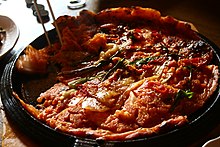
Kimchi buchimgae, a savoury Korean pancake with kimchi
- Gyeonggi-do (Lower Midwest of Hwanghae-do)
- Chungcheong-do (Between Gyeonggi-do and Jeolla-do): Instead of using fermented fish, people in the region rely on salt and fermentation to make savory kimchi. Chungcheong-do has the most varieties of kimchi.
- Gangwon-do (South Korea)/Kangwon-do (North Korea) (Mideast): In Gangwon-do, kimchi is stored for longer periods. Unlike other coastal regions in Korea, kimchi in this area does not contain much salted fish.
- Jeolla-do (Lower Southwest): Salted yellow corvina and salted butterfish are used in this region to create different seasonings for kimchi.
- Gyeongsang-do (Lower Southeast): This region's cuisine is saltier and spicier. The most common seasoning components include myeolchijeot (멸치젓) which produce a briny and savory flavor.
- Foreign countries: In some places of the world people sometimes make kimchi with western cabbage and many other alternative ingredients such as broccoli.[63][64]
Different types of kimchi were traditionally made at different times of the year, based on when various vegetables were in season and also to take advantage of hot and cold seasons before the era of refrigeration. Although the advent of modern refrigeration — including
kimchi refrigerators specifically designed with precise controls to keep different varieties of kimchi at optimal temperatures at various stages of fermentation — has made this seasonality unnecessary, Koreans continue to consume kimchi according to traditional seasonal preferences.
[65]

Dongchimi (동치미) is largely served during winter.
- Spring
After a long period of consuming
gimjang kimchi (
김장김치) during the winter, fresh
potherbs and vegetables were used to make kimchi. These kinds of kimchi were not fermented or even stored for long periods of time but were consumed fresh.
- Summer
Yeolmu radishes and cucumbers are summer vegetables made into kimchi,
yeolmu-kimchi (
열무김치) which is eaten in several bites. Brined fish or shellfish can be added, and freshly ground dried chili peppers are often used.
- Autumn
Baechu kimchi is prepared by inserting blended stuffing materials, called
sok (literally
inside), between layers of salted leaves of uncut, whole
Napa cabbage. The ingredients of
sok (
속) can vary, depending on the different regions and weather conditions. Generally,
baechu kimchi used to have a strong salty flavor until the late 1960s, before which a large amount of
myeolchijeot or
saeujeot had been used.
Gogumasoon Kimchi is made from sweet potato stems.
- Winter
Traditionally, the greatest varieties of kimchi were available during the winter. In preparation for the long winter months, many types of
kimjang kimchi (
김장 김치) were prepared in early winter and stored in the ground in large kimchi pots. Today, many city residents use modern
kimchi refrigerators offering precise temperature controls to store kimjang kimchi. November and December are traditionally when people begin to make kimchi; women often gather together in each other's homes to help with winter kimchi preparations.
[66] "Baechu kimchi" is made with salted
baechu filled with thin strips of
radish, parsley, pine nuts, pears, chestnuts, shredded red pepper,
manna lichen (
Korean:
석이 버섯;
RR:
seogi beoseot), garlic, and ginger.
Korean preference[edit]
A 2004 book about vegetable preservation said that the preference of kimchi preparation in Korean households from the most prepared type of kimchi to less prepared types of kimchi was: baechu kimchi, being the most prepared type of kimchi, then
kaktugi, then
dongchimi and then chonggak kimchi. The book said that baechu kimchi comprises more than seventy percent of marketed kimchi and radish kimchi comprises about twenty percent of marketed kimchi.
[67]
Nutrition and health[edit]
A 2003 article in the
Los Angeles Times said that South Koreans consume 18kg (40lbs) of kimchi per person annually.
[68] A 2015 book cited a 2011 source that said that adult Koreans eat from 50 grams (0.11 lb) to 200 grams (0.44 lb) of kimchi a day.
[69]
Some Koreans believe that kimchi helps them cope with their fast-paced lives.
[38] Kimchi is made of various vegetables and contains a high concentration of
dietary fiber,
[70][71] while being low in calories. One serving also provides over 50% of the daily recommended amount of
vitamin C and
carotene. Most types of kimchi contain onions, garlic, ginger, and chili peppers, all of which are
salutary. The vegetables used in kimchi also contribute to its overall nutritional value. Kimchi is rich in vitamin A, thiamine (B
1), riboflavin (B
2), calcium, and iron,
[72][73] and contains
lactic acid bacteria, among those the typical species
Lactobacillus kimchii.
[74][75][76]
During the
2003 SARS outbreak in Asia, many people believed that kimchi could protect against infection. While there was no scientific evidence to support this belief, kimchi sales rose by 40%.
[77][68]
However, kimchi may also contribute to
stomach cancer, which is the most common form of cancer in South Korea. In 2011, three Korean scientists reported that, "Kimchi, which is allegedly believed to have anti-carcinogenic properties, accounts for approximately 20% of sodium intake [in South Korea]. Case-control studies on the intake level of kimchi and gastric cancer risk generally showed an increased risk among subjects with high or frequent intakes of kimchi."
[78]
Despite some of these controversies, kimchi remains a staple in many Korean diets as there is a lot of evidence to support the abundant health functionalities of the product.
[79] Among these include cancer prevention, reduction in obesity, improving movement of food through the gastrointestinal tract to aid with constipation and promote colo-rectal health, enhancing the probiotic community in the body, reducing cholesterol, and providing antioxidative and anti-aging properties.
[79] Furthermore, it is also found to promote healthy brain function, enhance the immune system, and encourage healthy skin function.
[79]Nutritional composition of typical kimchi[80]
| Nutrients | per 100 g | Nutrients | per 100 g |
|---|
| Food energy | 32 kcal | Moisture | 88.4 g |
| Crude protein | 2.0 g | Crude lipid | 0.6 g |
| Total sugar | 1.3 g | Crude fiber | 1.2 g |
| Crude ash | 0.5 g | Calcium | 45 mg |
| Phosphorus | 28 mg | Vitamin A | 492 IU |
| Vitamin B1 | 0.03 mg | Vitamin B2 | 0.06 mg |
| Niacin | 2.1 mg | Vitamin C | 21 mg |
|
Vitamin Contents of Common Kimchi and Average Vitamin Contents of 4 Different Kimchi During Fermentation at 3–7°C
|
|---|
Fermentation
Time (Week) | Carotene
(μg%) | Vitamin
B1 (μg%) | Vitamin
B2 (μg%) | Vitamin
B12 (μg%) | Niacin
(μg%) | Vitamin C
(mg%) |
|---|
|
0
| 49.5a | 41.7 | 66 | 0.17 | 740 | 28.9 |
|
1
| 44.0 (35.4)b | 41.6 (40.1) | 47 (54) | 0.09 (0.09) | 781 (747) | 25.0 (25.3) |
|
2
| 32.0 (30.4) | 70.9 (61.9) | 110 (99) | 0.19 (0.20) | 928 (861) | 27.8 (28.5) |
|
3
| 26.6 (26.9) | 79.1 (87.5) | 230 (157) | 0.25 (0.33) | 901 (792) | 23.6 (22.3) |
|
4
| 21.0 (25.3) | 62.7 (70.8) | 35 (95) | 0.20 (0.26) | 591 (525) | 16.7 (16.0) |
|
5
| 24.2 (20.1) | 53.3 (49.1) | 40 (37) | 0.10 (0.16) | | 11.16 (11.0) |
aNaturally fermented baechu kimchi
bAverage levels of four different kimchis; common kimchi +3 different starter inoculated kimchis |
|
|
Source: Hui et al. (2005) who cited Lee et al. (1960)[81]
|
Production[edit]
South Korea consumes 1.85 million metric tons of kimchi annually, or nearly 80 pounds a person. It imports a significant fraction of that, mostly from China, and runs a $47.3 million kimchi trade deficit.
[82]
Procedure[edit]
The first step in the making of any kimchi is to slice the cabbage or daikon into smaller, uniform pieces to increase the surface area.
[83] The pieces are then coated as a preservative method, as this draws out the water to lower the free water activity. This inhibits the growth of undesirable microorganisms by limiting the water available for them to utilize for growth and metabolism.
[83] The salting stage can use 5 to 7% salinity for 12 hours, or 15% for 3 to 7 hours.
[54] The excess water is then drained away, and seasoning ingredients are added.
[83] The sugar that is sometimes added also acts to bind free water that still remains, further reducing free water activity. Finally, the brined vegetables are placed into an airtight canning jars and left to sit for 24 to 48 hours at room temperature.
[83] The ideal salt concentration during the fermentation process is about 3%.
[54] Since the fermentation process results in the production of carbon dioxide, the jar should be “burped” daily to release the gas.
[83]
Recent history[edit]
1996 Japanese kimchi dispute[edit]
In 1996, Korea protested against Japanese commercial production of kimchi arguing that the Japanese-produced product (
kimuchi) was different from kimchi (in particular, Japanese kimuchi was not fermented so it was salted like sweet cabbage). Korea lobbied for an international standard from the
Codex Alimentarius, an organization associated with the World Health Organization that defines voluntary standards for food preparation for international trade purposes.
[68][85] In 2001, the Codex Alimentarius published a voluntary standard defining kimchi as "a fermented food that uses salted napa cabbages as its main ingredient mixed with seasonings, and goes through a lactic acid production process at a low temperature", but which neither specified a minimum amount of fermentation nor forbade the use of any additives.
[86]
1998 to 2007 motherland tours[edit]
South Korea developed programs for adult
Korean adoptees to return to South Korea and learn about what it means to be Korean. One of these programs was learning how to make kimchi.
[87]
2010 kimchi ingredient price crisis[edit]
Due to heavy rainfall shortening the harvesting time for cabbage and other main ingredients for kimchi in 2010, the price of kimchi ingredients and kimchi itself rose greatly. Korean and international newspapers described the rise in prices as a national crisis.
[88] Some restaurants stopped offering kimchi as a free side dish, which
The New York Times compared to an American hamburger restaurant no longer offering free
ketchup.
[66] In response to the kimchi price crisis, the South Korean government announced the temporary reduction of tariffs on imported cabbage to coincide with the Kimjang season.
[89]
2012 effective ban of Korean kimchi exports to China[edit]
Since 2012, the Chinese government has effectively banned Korean kimchi exports to China through government regulations. Ignoring the standards of Kimchi outlined by the Codex Alimentarius, China defined kimchi as a derivative of one of its own cuisines, called
pao cai.
[90] However, due to significantly different preparation techniques from pao cai, kimchi has significantly more lactic acid bacteria through its fermentation process, which exceeds China's regulations.
[91] Since 2012, commercial exports of Korean kimchi to China has reached zero, the only minor amounts of exports accounting for Korean kimchi are exhibition events held in China.
[90]
Intangible Cultural Heritage of Humanity[edit]
Submitted by South Korea (inscribed 2013)[edit]
Kimjang, the tradition of making and sharing of kimchi that usually takes place in late autumn, was added to the list as "Kimjang, making and sharing kimchi in the Republic of Korea". The practice of Kimjang reaffirms Korean identity and strengthens family cooperation. Kimjang is also an important reminder for many Koreans that human communities need to live in harmony with nature.
[93]
Submitted by North Korea (inscribed 2015)[edit]
North Korean kimchi-making was inscribed on the list in December 2015
[92] as "Tradition of kimchi-making in the Democratic People's Republic of Korea".
[94] North Korean kimchi tends to be less spicy and red than South Korean kimchi.
[95]
2014 kimchi-making class for Vietnamese brides[edit]
A 2014 article in
Tuổi Trẻ said that around 40 Vietnamese brides who had already married or who were going to marry Korean men spent two hours in a class in 2014 to make kimchi and
kimbap at the Kim & Kim Company’s factory in the
Tân Bình Industrial Zone of
Ho Chi Minh City. The event was arranged by the Kim & Kim Company and the Korean Language Education Center in Ho Chi Minh City. The class is a free class that has been taught to 30 to 35 women once a month. Han Ji-sook, the director of the Korean Language Education Center in Ho Chi Minh City, said, "Kimchi is important for Korean people, so anyone who visits the country will experience kimchi or kimchi-making. Especially for the wives of Korean men, it's important to know how to make kimchi." Kim Tae-kon, director of the Kim & Kim Company, said, "All of these Vietnamese women who are going to live in Korea must eat kimchi every day, three meals a day. I'm pleased to give them the chance to learn how to make kimchi."
[96]
Boycott in China[edit]
A 2017 article in
The New York Times said that
anti-Korean sentiment in China has risen after South Korea's acceptance of the deployment of
THAAD in South Korea, Government-run Chinese news media has encouraged the boycott of South Korean goods, and Chinese nationalists have vowed to not eat kimchi.
[97]
Gallery[edit]
Preparation for making kimchi
Seokryu kimchi named after its pomegranate-like shape
Jang kimchi, pickled with soy sauce
Displayed manufactured kimchi
Oi-sobagi (cucumber kimchi)
See also[edit]


